
 Listing checkedFreemiumContact sales
Notion
Connected workspace that puts docs, wikis, databases and projects in one place, with Notion AI and agents working inside the same pages.
- Ratings
- No member reviews yet
- Price
- From $10/mo
- Last updated
Key takeaways
- Notion is a connected workspace that puts documents, wikis, relational databases, projects and collaboration on the same pages, with Notion AI and agents layered into them. The ratings hold up at volume: G2 is reported at 4.6/5 from 11,598 reviews and Capterra at 4.7/5 from 2,725 to 2,775 reviews in 2026, though counts vary by region and capture date.
- The past year rebuilt the product around AI: Agents shipped September 18, 2025, mobile AI and new model choices arrived January 20, 2026, Custom Agents on February 24, a Developer Platform on May 13 and calendar agent tools on July 16, 2026. AI access now separates the tiers, with Free and Plus limited to trial usage while Business and Enterprise carry the real allowance.
- Pricing looks simple. It is not. The Free plan is permanent, Plus is $10 and Business $20 per member per month as annual-billing rates, and Enterprise is custom. Agent automation runs on a separate credit add-on at $10 per 1,000 monthly credits; credits reset monthly, never roll over, and became mandatory for Custom Agents on May 4, 2026 and for Workers on August 11, 2026.
- Third-party estimates put Notion around 157 million monthly visits as of June 2026, but that figure was not independently verified and the monthly series behind it is volatile, so read it as a signal of scale rather than a measurement.
- The two caveats that matter most: the blank-canvas learning curve is the leading negative theme on G2, with 1,909 mentions counted by CheckThat, and billing is the sharpest reputational risk, with Trustpilot pages from January 2026 collecting complaints about unexpected charges and cancellation against a refund window of three days on monthly signups and 30 on annual.

What is Notion?
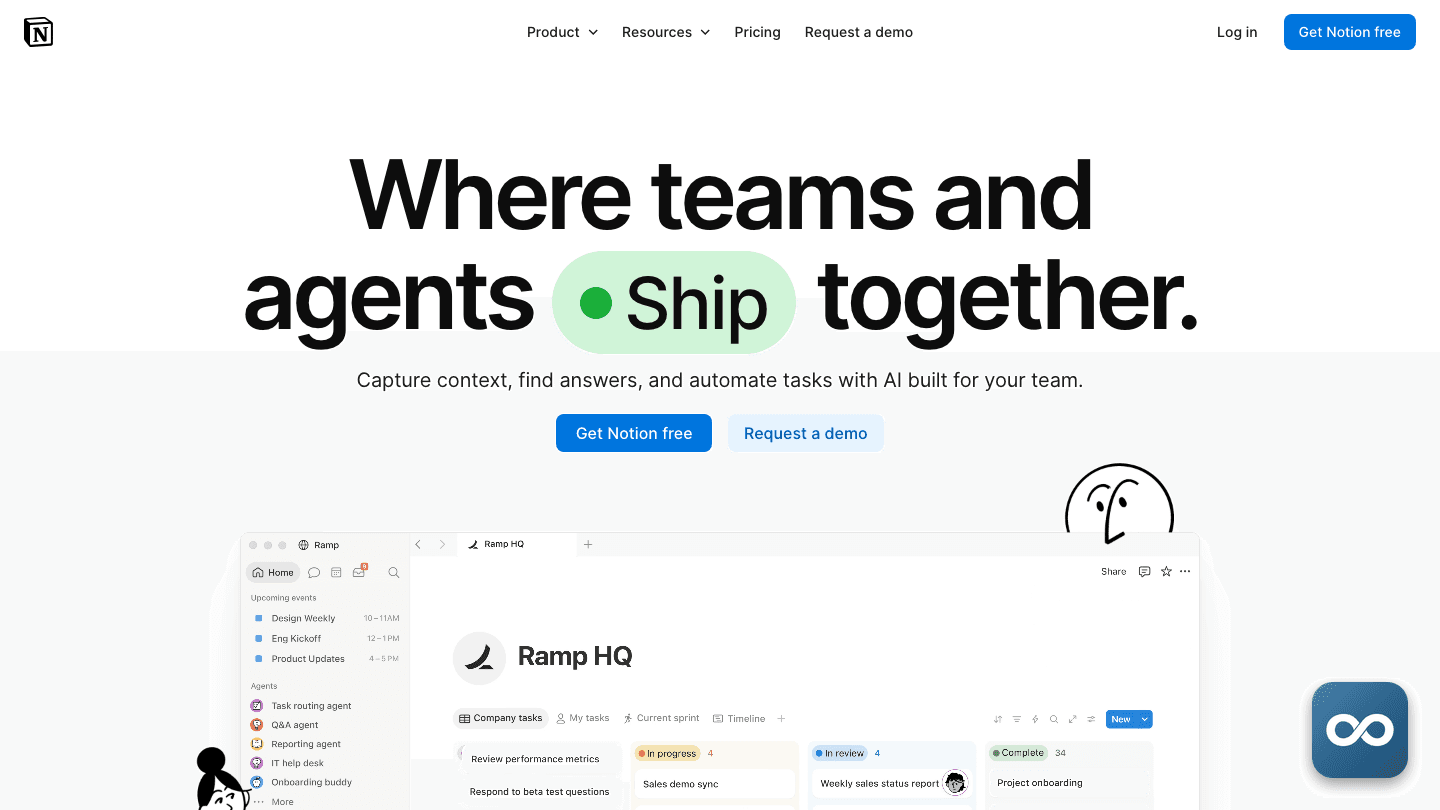
Notion is a hosted connected workspace at notion.com, sold under the homepage line "The AI workspace that works for you." It combines documents, wikis, databases, projects, tasks and collaboration in one configurable workspace, delivered through web, desktop and mobile apps, with Notion Calendar and Notion Mail as companion products and a Developer Platform for building on top. Notion is standalone commercial SaaS, not open source, and provides its own workspace and database interface while connecting external apps and AI subprocessors.
The founding ambition was a flexible tool that let ordinary users shape their software instead of accepting rigid productivity applications, and that still shows: pages are built from blocks, and relational databases with properties, views, forms and formulas sit underneath project and knowledge work. The AI layer now comes in three grades. Notion AI drafts, summarizes and answers questions with workspace context. Notion Agent works conversationally, creating and editing pages and databases using workspace and connected-app context. Custom Agents run recurring multi-step workflows on triggers or schedules, and connect over MCP to Linear, Figma and HubSpot. Notion says the models underneath are a mix it hosts itself and models from Anthropic and OpenAI, and it doesn't publish which version answers a given request; a January 2026 release lets users switch between the latest models. Notion's own value is the workspace context, retrieval, agents, automations and interface rather than a confirmed foundation model of its own.
Around the core sit Enterprise Search across connected sources like Slack and Google Drive, AI Meeting Notes, the Calendar and Mail products, and the Developer Platform launched May 2026, where developers build sync code and agent tools on Notion infrastructure and bring external agents like Claude or Codex into shared workspaces. The company behind it is privately held and reportedly based in San Francisco, with headcount around 1,800 according to database profiles and a reported $11 billion valuation at a January 2026 secondary tender.
How it works
Sign up and choose a workspace
Everyone starts with an account and a workspace. Individuals can stay on the permanent Free plan, teams pick Plus, Business or Enterprise, and eligible students and teachers can verify education access for a free Plus workspace. Notion runs in the browser and as desktop and mobile apps.
Build pages from blocks
Pages are assembled from flexible blocks: text, headings, embeds, tasks, files and databases. Pages nest into a wiki or a project workspace, so the same editor produces a meeting note, a spec or a company handbook.
Structure the work in databases
Database properties, relations, views, forms, charts, subtasks and dependencies turn pages into systems that track projects, roadmaps, campaigns or knowledge. Autofill populates properties automatically and formulas handle the calculated fields.
Ask, automate and share
Notion AI answers questions, drafts and summarizes, and searches connected apps. Notion Agent edits pages and databases on request, and Custom Agents run recurring work such as Slack answers, task routing and project updates on triggers or schedules. Results stay in the workspace or flow to connected tools: publish pages and sites, export documents, or work through Calendar and Mail. Paid AI usage and credits depend on your plan.
Features
Notion AI
Built into pages, docs, tasks and databases for drafting, summarizing and workspace-aware answers. You invoke it inline while writing, in an AI block on a page, or through Notion Agent, and it works with the pages you already have rather than with text you paste into a chat window. On Free and Plus it is limited trial usage; Business and Enterprise include broader access, subject to a usage allowance.
Research Mode
Point it at a topic and it investigates using workspace content, connected apps and the web, then writes a report into a page you can keep. Notion lists it under Enterprise in its plan comparison.
Notion Agent
A conversational agent that uses workspace and connected-app context to create and edit pages and databases for you, instead of only answering questions about them. It is included with the AI access on Business and Enterprise plans.
Custom Agents
Scheduled or triggered agents for recurring work: answering in Slack, routing tasks, posting project updates. They launched February 24, 2026, were free to try through May 3, and have consumed credits since May 4. MCP connections include Linear, Figma and HubSpot.
Enterprise Search and AI Connectors
One search across Notion plus connected sources such as Slack and Google Drive, so the answer to "where is that decision written down" stops depending on which tool it landed in. Availability depends on plan and workspace settings.
AI Meeting Notes
Captures and transcribes conversations, summarizes them and surfaces follow-up insights, so the meeting record lands in the same workspace as the project it belongs to. Included with Business-level AI access.
Databases, Autofill and formulas
Relational databases with views, forms, charts, subtasks and dependencies carry the structured side of the product, and Autofill fills in property values on its own. This is the layer that makes Notion a project and operations tool rather than a document editor.
Notion Developer Platform
Launched May 13, 2026, it lets developers build sync code and agent tools on Notion infrastructure and bring external agents such as Claude or Codex into shared workspaces. No public API price card was found, so check commercial terms before building against it.
What people use it for
- Centralizing company knowledge, SOPs and onboarding documentation
- Tracking roadmaps, engineering sprints and marketing campaigns with relational databases
- Generating weekly reports and routing repetitive operational tasks with Custom Agents
- Transcribing meetings and drafting actionable summaries and follow-ups
- Searching Slack, Google Drive and Notion without switching tools
- Scheduling meetings, drafting email and managing inbox workflows through Calendar and Mail
- Building developer syncs and agent tools on Notion infrastructure
Notion is not a strong fit for a local-first, end-to-end encrypted private notebook or for spreadsheet-scale data processing; independent reviews flag both the privacy model and performance on large databases (Try or Bye, 2026; Capterra, 2025).
Who it’s for
Pricing
Official pricingIndividual plans
Free
$0
per member / month
Individual use: core pages, docs, wikis and databases, with limited trial Notion AI.
Plus
$10
per member / month
Small teams: unlimited collaborative blocks, file uploads, forms and sites. Annual-billing rate; monthly price not published in our capture.
Business
$20
per member / month
Adds Notion AI with Notion Agent, AI Meeting Notes and Enterprise Search, subject to a usage allowance. Annual-billing rate.
Business plans
Enterprise
Custom
contact sales
SAML SSO, SCIM provisioning, audit logs and zero-data-retention defaults with LLM providers.
The advertised prices are annual-billing rates: Free is $0, Plus $10 and Business $20 per member per month, with Enterprise custom-priced, and the monthly-billing price for Plus was not published in our capture, so do not assume it matches. AI is the real dividing line: Free and Plus get limited trial usage of Notion AI, while Business adds Notion Agent, AI Meeting Notes and Enterprise Search under a usage allowance that can pause access once exhausted. Beyond the allowance, automation runs on credits sold as an add-on: $10 per 1,000 monthly credits that reset each month, or $13 per 1,000 annual credits paid upfront that expire at renewal, and neither rolls over. Credits are shared across the workspace and cover Custom Agents, Workers and extra Notion AI usage; Workers are typically estimated at $0.0023 per run, about 4,348 runs per 1,000 credits, while Custom Agent cost varies with the work performed. The free periods are over: Custom Agents began consuming credits May 4, 2026 and Workers on August 11, 2026. Refunds are narrow, a full refund only if you downgrade within three days of a monthly signup or 30 days of an annual one, with accidental added-member charges refundable pro rata if reported within three days of the invoice. Teams may be eligible for a 30-day Business trial, and verified students and teachers get Plus free for a one-member workspace.
Traffic & reach
These are third-party estimates, not company numbers, and this set deserves extra caution: the June 2026 figure of roughly 157 million monthly visits was not independently verified, no reliable August 2026 capture exists, and the monthly series behind it swings sharply, so treat the scale as directional. The shape of the traffic is more informative than the size: around three quarters of visits arrive direct, sessions average nearly eight minutes across nine pages, and brand searches run in the millions per month, which is what a bookmarked daily-use tool looks like rather than one people find through search.
Visits, June 2026
157.2M
▲ 370% month over month
Mar '26Jun '26
Top countries
- United States14%
- South Korea12%
- Japan10%
- India4.7%
- Brazil4.3%
Traffic sources
- Direct78%
- Organic search10%
- Organic social5.2%
- Referrals2.9%
- Email2.1%
- AI assistants1.2%
- Visits, last 3 months
- 208.8M
- Avg. visit
- 7m 49s
- Pages per visit
- 9.0
- Bounce rate
- 25.3%
- Brand searches / mo
- 6.8M
User reviews
Write a reviewNo reviews yet
Used Notion on something real? Write down what you made, what it cost and what the trade-off was. The next person can decide in about a minute from that.
Be the first to reviewWhat to know before you commit
What people rate it for. Review aggregators show strong sentiment at unusual volume: G2 at 4.6/5 from 11,598 reviews and Capterra at 4.7/5 from 2,725 to 2,775 in 2026. The recurring praise goes to the flexible block editor, the writing experience, configurable databases, templates and the ability to keep notes, projects and knowledge in one place. G2's 2025 analysis names organization, documentation and productivity consolidation as the core strengths.
The learning curve is the biggest filter. The most consistent criticism is the blank canvas. CheckThat reports learning curve as G2's leading negative theme with 1,909 mentions, and reviewers describe spending weeks learning databases, templates and page architecture. Reddit threads quoted in 2026 describe users who signed up, spent time in the tool, and still struggled to understand what it is.
It slows down at the edges. Independent reviews report slow or reloading mobile experiences, large databases becoming cumbersome, and limited spreadsheet-style data processing. These are editorial and consumer reports, not vendor benchmarks, but they recur across sources from 2025 and 2026.
AI pricing is the contentious part. Reviews describe the paid AI as expensive, the Free and Plus limits as restrictive, and the pricing changes as confusing; a March 2025 Capterra reviewer liked the free plan but said the paid plans deterred upgrading. The 2026 shift of Custom Agents and Workers onto credits is exactly the kind of change to recheck before budgeting.
Billing and support are the sharpest risk. Trustpilot regional pages retrieved January 2026 summarize complaints about unexpected charges, cancellation difficulty, account access and unhelpful support, while some of the same reviewers still praise the product itself. The site is self-selected and not representative, but the published refund windows are genuinely narrow: three days on monthly signups, 30 on annual.
Reliability is monitored by third parties, not published by Notion. Pulsetic counted 24 incidents in the 90 days it monitored through August 2026, four of them major or critical, covering downtime, degraded performance, AI automations and an August 2026 MCP authentication incident. This is third-party monitoring rather than Notion's own status history, and it's not a published uptime figure.
Hosted, not end-to-end encrypted. Privacy-conscious reviewers object that Notion can access hosted content because it isn't end-to-end encrypted. Notion's counterweight is policy: by default neither it nor its AI subprocessors train on Customer Data, Enterprise gets zero-data-retention defaults with LLM providers, non-Enterprise provider retention is generally 30 days or less, and the opt-in AI LEAP program is the exception that shares data. No confirmed breach, regulatory action or major lawsuit surfaced in the sources we checked, though absence of a result is not proof.
Alternatives to Notion

Frequently asked questions
Company & links
- Company
- Notion
- Founded
- 2013
- Founders
- Ivan Zhao, Simon Last
- Leadership
- Ivan Zhao is CEO and co-founder; Simon Last is co-founder and CTO. Notion's June 2026 board announcement names Jonathan Chadwick, Pat Grady, Gretchen Howard, Christopher Payne and Patrick Hsu as directors. The wider executive team includes Akshay Kothari as COO, Rama Katkar as CFO and Erica Anderson as CRO. The founding record is muddier than the leadership page: the company is generally dated to 2013 though some profiles say 2016, and Tracxn's founder list (Chris Prucha, Simon Last, Akshay Kothari, Jessica Lam, Toby Schachman) doesn't line up cleanly with the two-founder story, so treat the full founding roster as unresolved.
- Funding
- Notion is privately held and independent. The best available summary: undisclosed seed financing between 2013 and 2018 involving First Round Capital and Draft Ventures; an $18.2 million Series A in July 2019 led by Index Ventures at a reported $800 million valuation; a $50 million Series B in April 2020, also Index-led, at a reported $2 billion; a $275 million late-stage round in autumn 2021 led by Coatue and Sequoia at a reported $10 billion; and a $270 million secondary tender in January 2026 involving GIC, Sequoia and Index at an $11 billion valuation. The tender was a secondary sale, not new capital, and total-raised figures conflict across databases, with Tracxn reporting $418 million.
- Scale
- Database profiles put headcount at roughly 1,800 to 1,851 as of 2025 to 2026, not independently verified. A $500 million annual-revenue figure appears in one organization record but is not clearly company-reported and carries no methodology, so we do not treat it as verified. No profitability statement, layoff announcement or audited financials were found.
Try Notion on work you already know
A task you’ve done before is the fastest way to judge whether Notion fits your workflow and budget. Check the current plan terms on the official site before you subscribe.